Vending Machine Compliance Documents: Who Signs What
A vending machine arrives with a folder of paper that belongs to different people. Map each document before you order, not at the port.
Quick answer: 1942×1096×790 mm · +4°C to +25°C · 550 W
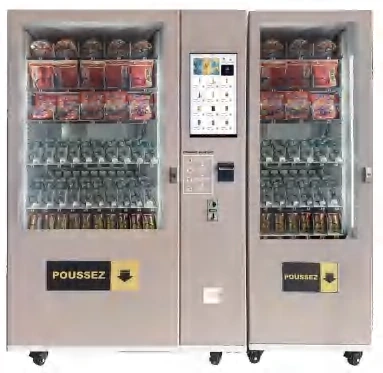
A vending machine reaches an importer with a folder of paper, and the folder usually mixes three different things: test reports issued to the Chinese manufacturer, declarations the importer is legally supposed to sign, and registrations that only exist in the destination country. Buyers who treat the folder as one package find out at the port, or at the first market-surveillance check, that the paper they are holding carries somebody else’s name.
This guide maps each document to the party responsible for it. It is written for the EU and UK market because that is where the split matters most, but the same logic applies wherever an importer becomes the local responsible operator.
Which documents travel with an imported vending machine?
A well-prepared shipment carries a safety test report for the model, a European or international conformity mark file where one exists, a declaration of conformity for the finished machine, food-contact declarations for the parts that touch product, radio approvals where the cabinet contains a wireless module, payment approvals for the terminal, and a technical file that ties all of it to the serial numbers in the crate. The certification coverage page lists what this factory holds per standard; the rest of this article explains who signs what.
The rule that causes most delays: a document proves something only if the right party signed it. A report proves the design was tested. A declaration proves someone takes legal responsibility. A registration proves a market has been informed. Importers often buy the first and assume they have the third.
What does CE marking on a vending machine actually cover?
CE marking on a vending cabinet is a self-declaration against the directives that apply to the product, not a certificate handed out by a laboratory. For a mains-powered cabinet the relevant ones are the Low Voltage Directive 2014/35/EU for equipment in its voltage range, the EMC Directive 2014/30/EU, and the RoHS Directive 2011/65/EU on restricted substances. Add the Radio Equipment Directive 2014/53/EU when the machine contains a Wi-Fi, Bluetooth or cellular module.
The cabinets in this range are built for 220-240 V AC, 50 Hz, as published on the snack and beverage models, so the Low Voltage Directive applies directly. A build for a 110-120 V market is a different configuration with a different component list, and the declaration has to describe the configuration actually shipped.
You can tell a serious supplier by what they send with the machine: the report should name the model, the standard and the laboratory, and the declaration should name the importer, the model and the directives. A page with a CE logo and no model number is decoration.
Which product standard is the cabinet tested against?
Commercial dispensing appliances and vending machines are tested against IEC 60335-2-75, adopted in Europe as EN IEC 60335-2-75, which supplements the general appliance safety standard EN IEC 60335-1. The scope covers appliances for preparing or delivering food, drinks and consumer products, up to 250 V for single-phase appliances, and the current edition extends to DC and battery-operated appliances. That matters for solar or battery-backed cabinets, which are no longer outside the test programme simply because they do not plug into a wall.
The standard assesses electrical, mechanical, thermal and hygiene hazards in one programme, which is why it is the document a food-service buyer should ask for by name. European work on cleanability has continued through amendments and drafts, aimed at surfaces that a site can actually clean and at access for cleaning under and behind the cabinet. When a machine is designed for a tight alcove, that access question is a design decision, not a cleaning habit.
One point buyers frequently get backwards: vending machines are not treated as machinery in the ordinary case. The European edition of the appliance standard records that the moving parts were assessed as electrical risk rather than machinery risk, so the Machinery Directive was not the route to conformity. The Machinery Regulation (EU) 2023/1230 replaces that Directive from 20 January 2027, and a build that adds anything beyond dispensing, such as a robotic arm or a lifting mechanism for a new product format, should be put to the conformity body as a scope question before production.
Who signs the declaration of conformity?
The declaration of conformity is signed by the economic operator that places the product on the market under its own name or trademark. If your company’s logo is on the cabinet, that operator is your company. That is the single most misunderstood sentence in this trade, and it is the reason a factory document pack can never substitute for the importer’s own file.
In practice the split looks like this. The factory supplies test reports, component and material declarations, drawings, the bill of materials, the manual and the marking artwork. The importer, or its EU-established representative where the rules require one, assembles the technical file, signs the declaration, and holds it for the retention period the rules set. Market surveillance authorities ask the operator on the label, not the factory that built the cabinet.
The document map
| Document | Issued by | Signed or held by | What it proves |
|---|---|---|---|
| Safety test report (EN IEC 60335-2-75) | Accredited laboratory | Factory, passed on to importer | The tested model meets the standard |
| Declaration of conformity | Economic operator placing the machine on the market | Importer or own-brand seller | Someone is legally responsible |
| Technical file | Importer, assembled from factory inputs | Importer | The claim can be reconstructed |
| Food-contact declarations | Material and component suppliers | Factory, passed on to importer | Parts in contact with product are suitable |
| Radio approval (RED) | Laboratory and notified body where required | Supplier of the module and the finished build | The wireless function may be placed on the market |
| Payment approvals (EMV, PCI) | Payment schemes and laboratories | Terminal supplier, then the operator | The payment path is accepted by acquirers |
| WEEE, battery and packaging registration | National registers and schemes | Importer, per country | The market has been informed and financed |
The table is a planning tool, not legal advice; the applicable rules and the retention period depend on the country and on the configuration you order.
What changes when the machine handles food?
As soon as the cabinet dispenses anything edible, a second document family appears. The framework is Regulation (EC) No 1935/2004 on materials in contact with food, with Regulation (EU) No 10/2011 for plastics and Regulation (EC) No 2023/2006 on good manufacturing practice. Coffee brewers, fresh-food cabinets and heated platforms need declarations for every wetted part: tubing, mixing bowls, trays, gaskets and dispensing nozzles.
Two practical consequences. First, ask for declarations per model rather than one general letter, because the fresh food line and the packaged-goods cabinets share a chassis but not a wetted-parts list. Second, the machine must be cleanable to the standard the operator’s own food-safety registration assumes, so access to the dispensing area belongs in the specification, next to the temperature range.
What sits inside the payment and telemetry hardware?
Payment is where imports fail quietly. A card reader carries its own EMV approvals, level 1 for the hardware and level 2 for the payment application, and the estate around it carries PCI obligations. None of those are inherited by the vending machine, and the machine’s CE file does not cover them. A QR-only build in a market where cards dominate is a commercial problem rather than a compliance one, but the payment options guide covers that side.
Telemetry is the other half. A cabinet with a 4G router or a Wi-Fi module needs radio approval for the module and an assessment of the finished product, and the antenna placement inside a steel cabinet is part of that assessment. MDB and DEX, which appear on every specification sheet, are interface protocols, not certificates; they tell you the machine can talk to a terminal and a remote platform, not that anything has been approved.
What must be registered before the machine can be sold?
Registration is the step factories cannot do for you, because it is tied to a legal entity in the destination country. Vending machines are electrical and electronic equipment, and environmental agencies treat them as business-to-business equipment; the Irish regulator, for example, names vending machines explicitly in its guidance for B2B producers, where the importer that places them on the market is the producer and self-complies rather than joining a household scheme. Germany runs the same logic through its national register, with registration required before the first sale.
Three more strands usually apply: a battery in the controller or the payment terminal brings battery obligations, packaging rules cover the crate and the inner packaging, and the machine has to carry the crossed-out bin symbol with the producer’s identification. In Great Britain, CE marking has continued to be recognised under the 2024 product safety amendments, so a CE-marked cabinet can be placed on the GB market, but UK waste registration is still separate from the EU one. Confirm the current position with your compliance provider for each country you ship to.
What should the purchase contract specify?
Put the documents in the contract, not in an email thread. Name the standard the machine will be tested against, state which party signs the declaration, list the language of the manual and the labels, and require the test report, the technical file inputs and the spare-parts list to be delivered before the balance payment. Then tie the serial numbers in the crate to the file: a machine that cannot be matched to a report is a machine with no evidence.
For a first order, the cheapest insurance is a written document schedule agreed with the OEM scope, checked by whoever will hold the file at destination. Our team will tell you plainly which documents we issue, which we hand over as inputs, and which only your company can sign. Request a quotation with the destination country and the intended sales channel, and the document list comes back with the price.
Frequently asked questions
Is a CE certificate from the factory enough to sell in the EU?
No. A laboratory report issued to the factory is evidence, not market access. The declaration of conformity must be signed by the economic operator that places the machine on the EU market under its own name, which is usually the importer.
Which standard applies to a vending machine?
The safety of commercial dispensing appliances and vending machines is covered by IEC 60335-2-75 and its European adoption EN IEC 60335-2-75, which supplements EN IEC 60335-1. Electrical, mechanical, thermal and hygiene hazards are assessed together in that programme.
Does a vending machine need a machinery declaration?
The appliance standard is written under the Low Voltage framework and records that the moving parts were assessed as electrical risk. If a build adds anything beyond dispensing, ask the conformity body whether the Machinery Directive or the Machinery Regulation applies.
Do I need to register the machine in my own country?
Usually yes. Vending machines are electrical and electronic equipment, so the importer registers as a producer under the national WEEE rules of each country where it sells, and often under packaging and battery rules too.
Who keeps the technical file?
The operator that signs the declaration. In practice the importer holds it for the retention period the rules set, with the factory supplying test reports, component declarations and drawings.
Next step
Turn this guide into a configured machine
Send the product list, site conditions and target volume. We reply with a configuration, lead time and quotation — usually within one business day.
Machines mentioned in this article
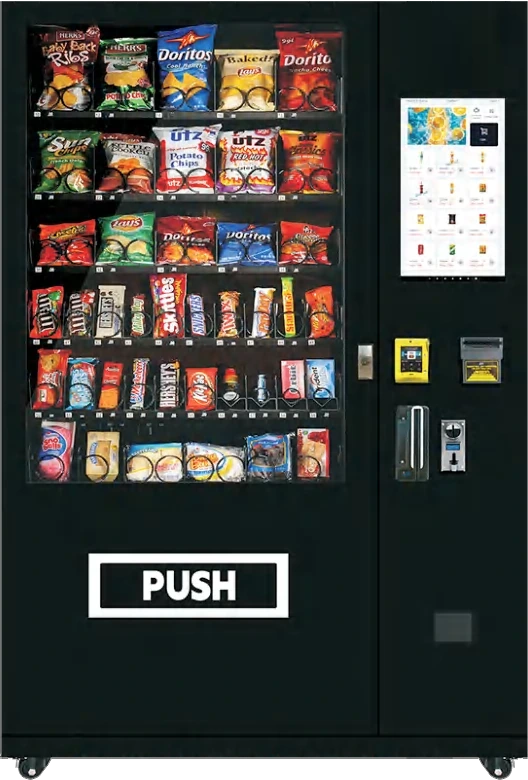 Flagship
Snacks & drinks
60-Slot Touchscreen Vending Machine
Six shelves, 300 items and a 7.1-inch touchscreen for drinks and snacks.
View details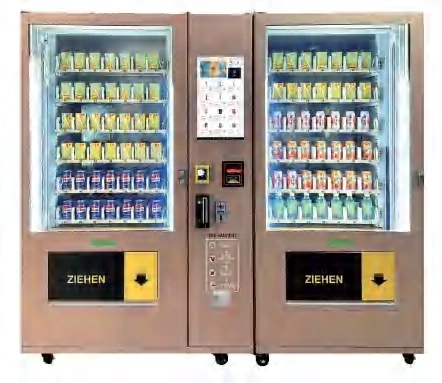 Flagship
Snacks & drinks
AA Combo Elevator Vending Machine
Two linked elevator cabinets, 540 items and one payment terminal.
View details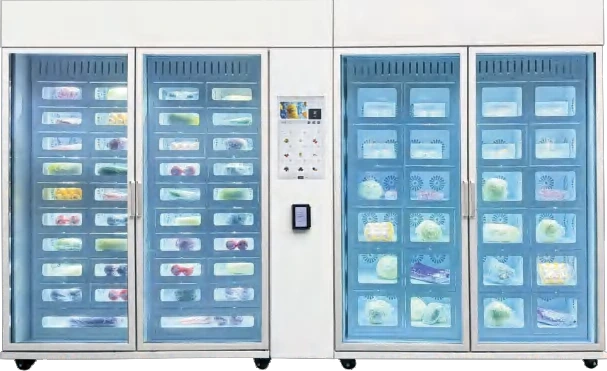
Lockers & smart cabinets
62-Compartment Refrigerated Locker
Sixty-two chilled doors for food, flowers and pharmacy.
View configuration