Micro Market vs Vending Machine: What to Choose
How an unattended micro market works, what equipment and software it needs, and when it beats a bank of vending machines.
Quick answer: 1950×2700×350 mm · 100 W · 220–240 V AC, 50 Hz
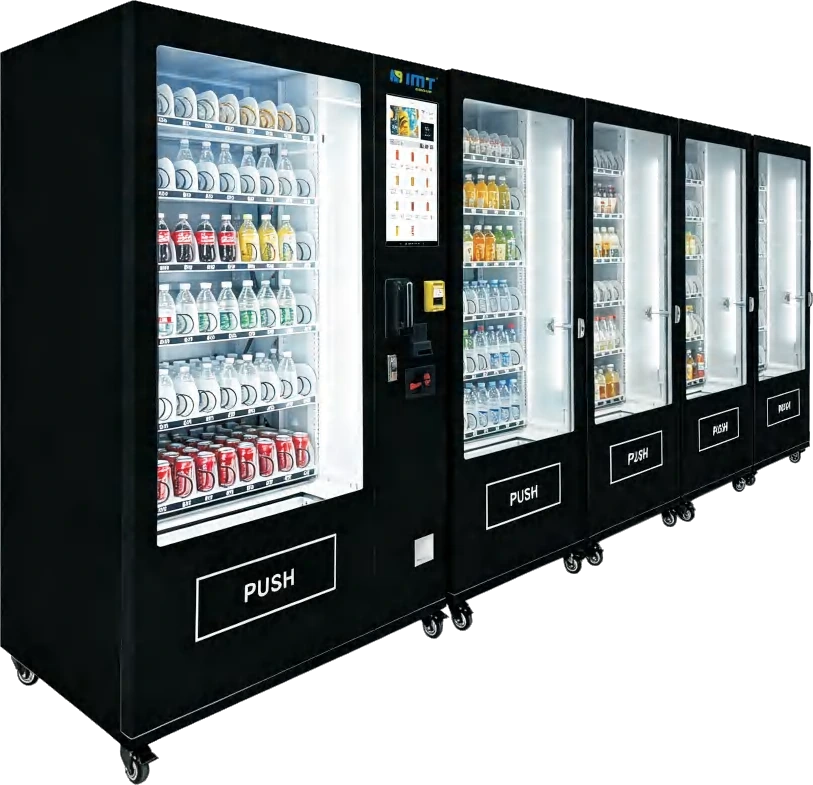
A micro market is a small unattended shop. Instead of a bank of vending machines, the site has shelving, refrigerated display, a self-checkout terminal and a defined user group. The customer picks several items, scans or weighs them, pays, and leaves. The operator restocks on a route rather than staffing a counter.
The format sits between vending and a convenience store. It carries more assortment than a vending machine and less overhead than a staffed shop, which is why it appears in offices, factories, hospitals, campuses and residential buildings. This guide explains the equipment, the software and the conditions that decide whether a micro market is the right answer. The office and factory solution shows how the format fits a workplace, and the product overview maps the equipment families.
What is a micro market?
A micro market is a compact, self-service retail space for a closed or semi-closed group. The typical installation has a refrigerated display for drinks and fresh food, ambient shelving for snacks and packaged goods, a self-checkout kiosk, and sometimes a coffee machine or a locker bank. Access may be open to anyone in the building or restricted by a badge or account.
The key difference from vending is the assortment. A vending machine sells what fits its slots. A micro market sells what fits its shelves, which means larger packs, family sizes, fresh food, local products and seasonal items. The key difference from a convenience store is the labor model: no cashier, no daily opening and closing, and a restocking route instead of a shift.
How is a micro market different from vending machines?
Vending machines optimize for a small footprint, a closed transaction and low labor. A micro market optimizes for assortment and basket size. The customer can pick up several items, compare packs and buy a meal plus a drink in one visit.
| Feature | Vending machine bank | Micro market |
|---|---|---|
| Assortment | Limited by slots and coils | Shelving and refrigerated display |
| Basket size | Usually one or two items | Several items per visit |
| Footprint | Small, against a wall | A room or a defined area |
| Staffing | None | None on site; route restocking |
| Payment | Per machine | One checkout for the basket |
| Loss control | Physical containment | Checkout, weight checks, audit, access control |
| Best fit | Corridors, lobbies, small sites | Offices, factories, campuses, residential buildings |
A vending bank can be installed in a corridor with a power point. A micro market needs floor area, refrigeration, shelving and a checkout, plus a plan for cleaning and access. The capital and operating requirements are higher, but so is the sales ceiling.
How is it different from an unmanned store?
The terms are often used interchangeably, but the scale differs. An unmanned store is the broader concept: a retail space without staff, using self-checkout, smart shelves or closed cabinets. A micro market is usually a compact version designed for a known user group, with a smaller assortment and a simpler checkout.
An unmanned store open to the public needs stronger identity, payment and loss-prevention systems than a micro market inside an office. A micro market inside a factory can rely on the badge system and the social accountability of a closed group. The technology should match the openness of the site, not the label on the project.
What equipment does a micro market need?
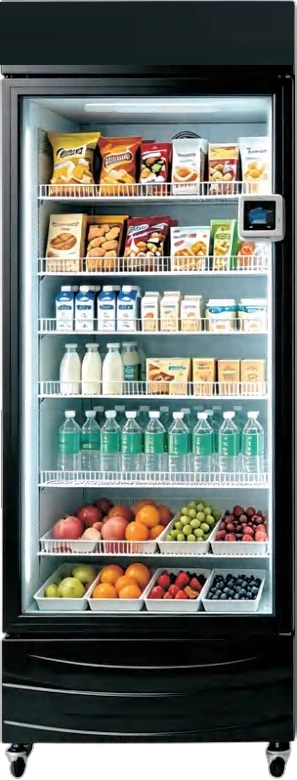
The core is refrigeration. Drinks and fresh food need a display fridge that keeps product at the right temperature and shows it clearly. The NFC smart fridge is one option for a closed, account-based format; a refrigerated locker or a conventional glass-door display is another. The fresh food line covers the heated and chilled platforms that sit alongside a market.
Ambient shelving carries snacks, packaged goods and household items; the snack and beverage line covers the packaged-goods side. A self-checkout kiosk handles scanning, weighing and payment. A coffee or hot drink machine adds a high-margin category; the coffee platform is a common anchor. A locker bank can hold pre-ordered meals or high-value items; the locker range covers ambient and chilled formats, including the ambient locker cabinet. For non-food categories, a general merchandise cabinet can extend the assortment without adding a staffed counter.
The vending equipment does not disappear in every project. Many micro markets keep a combo vending machine or a bento box cabinet for the categories that work better in a closed cabinet. The format is a mix, not a religion.
Which locations support a micro market?
The best sites have three properties: a stable user group, enough daily footfall and a secure space. Offices with 100 or more staff, factories with shift patterns, hospitals with staff and visitors, campuses and large residential buildings are typical.
The site also needs the physical conditions: floor area, power, ventilation, network coverage and a restocking access route. A micro market in a basement with no mobile signal needs a network plan before it needs a shelving plan. The residential solution and the transit hub solution show how the same format adapts to different user groups, and the education solution covers campus sites.
A micro market is a poor fit for a site with low footfall, no secure space or a user group that changes daily. In those cases a vending bank is cheaper to install and easier to move.
How does checkout and loss prevention work?
The checkout is the heart of the operation. A self-checkout kiosk scans barcodes, weighs loose items and accepts card or QR payment. A smart fridge or smart shelf can detect what was taken and charge the account automatically. A locker bank avoids the problem entirely by keeping every item behind a door until payment.
Loss prevention is a design decision, not a single device. A closed user group with an account, a receipt and an audit trail is the strongest control. Weight checks and cameras add evidence. A fully open shelf in a public location needs more technology and more supervision than a closed cabinet in a staff canteen.
Ask for the exception workflow: what happens when a customer claims a wrong charge, when an item is missing from the shelf, or when the kiosk goes offline. A format that cannot handle exceptions will create manual work for the operator. The payment options guide covers the payment side in more detail.
What software runs a micro market?
The software has to do more than a vending machine’s platform. It needs a product catalogue, a planogram or shelf map, inventory by location, price management, checkout, payment reconciliation, temperature monitoring and remote support. It also needs a restocking workflow that tells the route team what to bring.
The software line describes the standard stack used with VendHarbor hardware. For a micro market, confirm that the platform can handle multiple equipment types — fridges, lockers, coffee machines and kiosks — under one site view. A platform that manages only one cabinet type creates a second system for every format.
Integration matters. If the site uses a badge system, a loyalty app or an ERP, the micro market should exchange data with it. A closed platform that cannot export sales by SKU is a reporting dead end.
What does the operating model look like?
A micro market is a route business with a retail assortment. The operator plans the product mix, sets prices, restocks on a schedule, checks temperatures, cleans the space and handles customer service. The machine or kiosk handles the transaction; the operator handles the assortment.
The restocking routine is more complex than a vending route. Shelves need facing, expiry dates need rotation, and the checkout needs a price file that matches the shelf labels. A micro market with a weak planogram turns into a shrinking assortment and a growing write-off line.
The route planning guide explains how to set service intervals and how to use sales data to adjust the planogram. The cost guide explains the capital and operating cost structure, and the selection framework covers the product-list decisions that apply to both formats.
When should you choose vending machines instead?
Choose vending when the site is small, the footfall is low, the product mix is narrow, or the space is a corridor rather than a room. Choose vending when the operator cannot support daily restocking and cleaning. Choose vending when the capital budget is limited and the site needs to be live quickly.
Choose a micro market when the assortment is the reason customers will change behavior: fresh food, larger packs, local brands, meal deals. Choose it when the site has a stable user group and enough daily transactions to justify the fit-out. Choose it when the operator can commit to the restocking and cleaning routine.
Many projects start with a vending bank and add a micro market later, once the site data proves the demand. That sequence is usually cheaper than building a full market on an untested assumption. The smart cabinet guide and the vending locker guide explain the intermediate formats.
For a site review, contact the VendHarbor team with the user group, daily footfall, available floor area and product list. The office coffee and lunch case shows how a workplace installation combines machines rather than relying on a single format, and the residential smart fridge and locker case shows the closed-cabinet alternative.
Next step
Turn this guide into a configured machine
Send the product list, site conditions and target volume. We reply with a configuration, lead time and quotation — usually within one business day.
Machines mentioned in this article
 Flagship
Lockers & smart cabinets
NFC AI Smart Fridge
Open the door, take the item and charge the account automatically.
View detailsSnacks & drinks
Multi-Function Combination Vending Machine
Mix ambient, refrigerated and specialty modules in one installation.
View configuration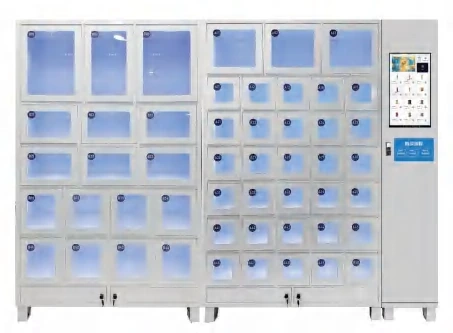 Flagship
Lockers & smart cabinets
50-Compartment Locker Vending Machine
Fifty independent doors in a 350 mm-deep cabinet.
View details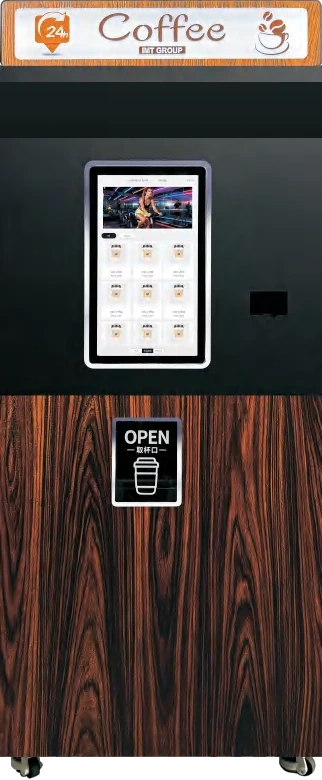 Flagship
Fresh food & drinks
Freshly Ground Coffee Vending Machine
Bean-to-cup coffee, six instant canisters and 150 cups per fill.
View details